Tuesday, January 25, 2011

Feast of the Conversion of St. Paul

Here is today’s second reading from the Office of Readings, a selection from a homily on St. Paul by St. John Chrysostom. Emphases, in bold, and comments, in red, are mine.

***

Paul, more than anyone else, has shown us what man really is, and in what our nobility consists, and of what virtue this particular animal is capable. Each day he aimed ever higher; each day he rose up with greater ardor and faced with new eagerness the dangers that threatened him. He summed up his attitude in the words: I forget what is behind me and push on to what lies ahead. When he saw death imminent, he bade others share his joy: Rejoice and be glad with me! And when danger, injustice and abuse threatened, he said: I am content with weakness, mistreatment and persecution. These he called the weapons of righteousness, thus telling us that he derived immense profit from them.

Thus, amid the traps set for him by his enemies, with exultant heart he turned their every attack into a victory for himself; constantly beaten, abused and cursed, he boasted of it as though he were celebrating a triumphal procession and taking trophies home, and offered thanks to God for it all: Thanks be to God who is always victorious in us! This is why he was far more eager for the shameful abuse that his zeal in preaching brought upon him than we are for the most pleasing honors, more eager for death than we are for life, for poverty than we are for wealth; he yearned for toil far more than others yearn for rest after toil. The one thing he feared, indeed dreaded, was to offend God; nothing else could sway him. Therefore, the only thing he really wanted was always to please God.

The most important thing of all to him, however, was that he knew himself to be loved by Christ. (I think this should also be a theme in the spirituality of consecrated virgins.) Enjoying this love, he considered himself happier than anyone else; were he without it, it would be no satisfaction to be the friend of principalities and powers. He preferred to be thus loved and be the least of all, or even to be among the damned, than to be without that love and be among the great and honored.

To be separated from that love was, in his eyes, the greatest and most extraordinary of torments; the pain of that loss would alone have been hell, and endless, unbearable torture.

So too, in being loved by Christ he thought of himself as possessing life, the world, the angels, present and future, the kingdom, the promise and countless blessings. Apart from that love nothing saddened or delighted him; for nothing earthly did he regard as bitter or sweet.

Paul set no store by the things that fill our visible world, any more than a man sets value on the withered grass of the field. As for tyrannical rulers or the people enraged against him, he paid them no more heed than gnats. Death itself and pain and whatever torments might come were but child’s play to him, provided that thereby he might bear some burden for the sake of Christ.

Friday, January 21, 2011

Feast of St. Agnes 2011

An ancient hymn to St. Agnes, virgin and martyr, in Latin with English translation (taken from the blog “What Does the Prayer Really Say?”)

Igne divini radians amoris
corporis sexum superavit Agnes,
et super carnem potuere carnis
claustra pudicae.

Shining with the fire of divine love
Agnes overcame the gender of her body,
and the undefiled enclosures of the flesh
prevailed over flesh.


Spiritum celsae capiunt cohortes
candidum, caeli super astra tollunt;
iungitur Sponsi thalamis pudica
sponsa beatis.

The heavenly host took up her brilliant white spirit,
and the heavens lifted it above the stars;
the chaste bride is united to the
blessed bride chambers of the Spouse.

Virgo, nunc nostrae miserere sortis
et, tuum quisquis celebrat tropaeum,
impetret sibi veniam reatus
atque salutem.

O virgin, now have pity on our lot,
and, whoever celebrates your victory day,
let him earnestly pray for forgiveness of guilt
and salvation for himself.

Redde pacatum populo precanti
principem caeli dominumque terrae
donet ut pacem pius et quietae
tempora vitae.


Give back to this praying people
the Prince of heaven and Lord of the earth,
that he, merciful, may grant us peace
and times of tranquil living.

Laudibus mitem celebremus Agnum,
casta quem sponsum sibi legit Agnes,
astra qui caeli moderatur atque
cuncta gubernat. Amen.


Let us celebrate with praises the gentle Lamb,
whom chaste Agnes binds to herself as Spouse,
he who governs the stars of heaven
and guides all things. Amen.

Monday, January 3, 2011

Feast of St. Genevieve

Today is not only my second anniversary (Deo gratias!) but also my name day. Today is the feast of St. Genevieve, who is my patron saint. My real first name is “Jenna,” which my mother chose as a shortened, Americanized version of my grandmother’s name, Genevieve.

For some reason, St. Genevieve isn’t a very popular saint in the United States (although many of European Sisters of St. John whom I know have a special love for her). But she’s a wonderful saint for young women in general, and for consecrated virgins “living in the world” especially.

Here is a brief summary of her life, which I adapted slightly from the Catholic Encyclopedia entry on NewAdvent.org. Emphases in bold, and comments in red, are mine.

***

Patroness of Paris, b. at Nanterre, c. 419 or 422; d. at Paris, 512. Her feast is kept on January 3. She was the daughter of Severus and Gerontia; popular tradition represents her parents as poor peasants, though it seems more likely that they were wealthy and respectable townspeople.

In 429 St. Germain of Auxerre and St. Lupus of Troyes were sent across from Gaul to Britain to combat Pelagianism. On their way they stopped at Nanterre, a small village about eight miles from Paris. The inhabitants flocked out to welcome them, and St. Germain preached to the assembled multitude.

It chanced that the pious demeanor and thoughtfulness of a young girl among his hearers attracted his attention. After the sermon he caused the child to be brought to him, spoke to her with interest, and encouraged her to persevere in the path of virtue. (St. Germain seems to have been encouraging of young vocations!) Learning that she was anxious to devote herself to the service of God, he interviewed her parents, and foretold them that their child would lead a life of sanctity and by her example and instruction bring many virgins to consecrate themselves to God. Before parting next morning he saw her again, and on her renewing her consecration (this must have been something like a simple pledge or promise) he blessed her and gave her a medal engraved with a cross, telling her to keep it in remembrance of her dedication to Christ. He exhorted her likewise to be content with the medal, and wear it instead of her pearls and golden ornaments.

There seem to have been no convents near her village (actually, St. Genevieve lived just before the advent of western religious life properly so-called—she died about thirty years before the Rule of St. Benedict was written); and Genevieve, like so many others who wished to practice religious virtue, remained at home, leading an innocent, prayerful life. (She was an excellent example of a consecrated virgin “living in the world.” I find it wonderfully providential that my patroness had a vocation to the exact same form of consecrated life to which I was also called.) It is uncertain when she formally received the religious veil (St. Genevieve didn’t just “receive the veil”—from all appearances, it seems that she was consecrated according to an ancient version of the Rite of Consecration to a Life of Virginity). Some writers assert that it was on the occasion of St. Gregory’s return from his mission to Britain; others say she received it about her sixteenth year, along with two companions, from the hands of the Bishop of Paris.

On the death of her parents she went to Paris, and lived with her godmother. She devoted herself to works of charity and practiced severe corporal austerities, abstaining completely from flesh meat and breaking her fast only twice in the week. These mortifications she continued for over thirty years, until her ecclesiastical superiors thought it their duty to make her diminish her austerities. Many of her neighbors, filled with jealousy and envy, accused Genevieve of being an impostor and a hypocrite. Like St. Joan of Arc in later times, she had frequent communion with the other world, but her visions and prophecies were treated as frauds and deceits. Her enemies conspired to drown her; but, through the intervention of St. Germain of Auxerre, their animosity was finally overcome.

The bishop of the city appointed her to look after the welfare of the virgins dedicated to God, and by her instruction and example she led them to a high degree of sanctity. (Because of this point, I think it would be good if we consecrated virgins regularly sought St. Genevieve’s prayerful intercession as we strive to develop solid formation programs for modern aspiring consecrated virgins.)

In 451 Attila and his Huns were sweeping over Gaul; and the inhabitants of Paris prepared to flee. Genevieve encouraged them to hope and trust in God; she urged them to do works of penance, and added that if they did so the town would be spared. Her exhortations prevailed; the citizens recovered their calm, and Attila’s hordes turned off towards Orléans, leaving Paris untouched. (As a consecrated virgin from New York, I try to imitate St. Genevieve in praying for the temporal and spiritual safety of my own metropolitan area.) Some years later Merowig (Mérovée) took Paris; during the siege Genevieve distinguished herself by her charity and self- sacrifice. Through her influence Merowig and his successors, Childeric and Clovis, displayed unwonted clemency towards the citizens.

It was she, too, who first formed the plan of erecting a church in Paris in honor of Saints Peter and Paul. It was begun by Clovis at Mont-lès-Paris, shortly before his death in 511. Genevieve died the following year, and when the church was completed her body was interred within it. This fact, and the numerous miracles wrought at her tomb, caused the name of Sainte-Geneviève to be given to it. St. Genevieve’s relics were preserved in her church until the time of the French Revolution.

Through the centuries, Paris received striking proof of the efficacy of her intercession. Prayerful devotion to St. Genevieve saved the city from complete inundation in 834. And in 1129 a violent plague, known as the mal des ardents, carried off over 14,000 victims, but it ceased suddenly during a procession in her honor.

Saturday, December 25, 2010

Christmas 2010

1. Lo, how a rose e’er blooming,
From tender stem hath sprung!
From Jesse’s lineage coming,
As men of old have sung.
It came, a floweret bright,
Amid the cold of winter
When half spent was the night

2. Isaiah ‘twas foretold it,
The Rose I have in mind
With Mary we behold it,
The Virgin mother kind
To show God’s love aright,
She bore to us a Savior
When half spent was the night

3. The shepherds heard the story
Proclaimed by angels bright,
How Christ, the Lord of Glory
Was born on earth this night.
To Bethlehem they sped
And in the manger they found him,
As angels heralds said.

4. This Flower, whose fragrance tender
With sweetness fills the air,
Dispels with glorious splendor
The darkness everywhere;
True man, yet very God,
From Sin and death he saves us,
And lightens every load.

(And now, more singing seminarians…)

Thursday, December 16, 2010

Consecrated Virginity versus Private Vows

(Image: St. Catherine of Siena, a great saint who is popularly called a “consecrated virgin living in the world,” but who was actually a third-Order Dominican who professed a private vow of virginity.)

Some of the kinds of questions I’m asked most frequently, whether through email or in real life, have to do with the differences between the Rite of Consecration to a Life of Virginity and the profession of a private vow of virginity.

Often, consecrated virginity and private vows are identified with each other—or sometimes even considered to be the same thing! However, on a theological and canonical level, reception of the Rite of Consecration to a Life of Virginity is very different from the profession of a private vow.

Consecrated virginity, like religious life, is a public state of consecration; whereas a private vow of virginity (or celibate chastity) is, by its very nature, private.

But what does this actually mean?

Basically, a state of consecration is “public” when it is recognized as being so by the proper authority in the institutional Church (for a consecrated virgin, this would be the bishop of her diocese; for a nun or religious Sister, this would be the legitimate major superior of her community). If a commitment to celibacy or virginity is NOT officially recognized in this way, then it is considered “private” or personal.

Perhaps in contrast with the more colloquial usage of these two terms, “public” and “private” commitments to perpetual virginity have less to do with how many people witness or are aware of such a commitment, as it does with whether or not that commitment was formally accepted in the name of the Church. For example, a consecrated virgin who had only the bishop present at her consecration (or a religious whose profession of vows was attended by only her superior and the required two witnesses) would still be a publically consecrated person. However, even if a woman were to make a private vow of virginity in front of hundreds of people, with her picture and her story printed in the diocesan newspaper, this would not make her private vow into a public one according to the way in which the Church uses these two terms.

Yet with all this being said, it’s also worth noting that in almost all circumstances the Church usually does intend public vows or consecrations to be “public” in the more common sense of the word. I.e., the Rite of Consecration to a Life of Virginity and the Rite of Religious Profession both explicitly state that the faithful should be invited to attend both these rituals, and publicly consecrated persons are for the most part expected to be open about their special identity within the Church.

Conversely, those who have made private vows are generally advised not to present themselves as though they were publically consecrated persons, which in many cases can mean that they are discreet about their commitment to the evangelical counsels.

In other words, we could say that entrance into a public state of consecrated life not only involves God and the person to be consecrated, but also the Church’s magisterium and the entire visible body of Christ. But on the other hand, a private vow is essentially a matter which is for the most part between God and the individual soul.

Understanding the nature of liturgy and public consecration

From my point of view, one helpful way of understanding the difference between public and private commitments to the evangelical counsels is to reflect on the similar difference between public and private forms of prayer—that is, between the Church’s liturgy and personal devotions.

In the Catholic Church, the Divine Office, the Mass, the Sacraments, and other rites (such as the Rite of Consecration to a Life of Virginity, the rite for the consecration of a Church, the blessing of an Abbot or Abbess, ect.) are all considered liturgy. By definition, liturgy is the public, official prayer of the Church. This means that those who are engaged in praying the Church’s liturgy aren’t speaking to God in their own name as much as they are speaking to God on behalf of the Church herself. They pray, not in their own voice, but with the voice of the Church.

For instance, even while it is certainly to be hoped that Catholics who recite the Liturgy of the Hours will interiorize the psalms, canticles, and other prayer to the point where they can be said truly to “make them their own,” the Liturgy of the Hours isn’t intended as a reflection of the interior state of any one individual.

Likewise, the holy sacrifice of the Mass isn’t “about” the particular spiritual life of any one priest or parish, which is why the prayers and rubrics can’t be changed by anyone except the Holy See—even if there was a situation where an individual priest sincerely felt that an alteration to prayers of the Mass would make the liturgy subjectively more “meaningful” to his particular community.

In contrast to this, private or devotional prayers are prayers wherein we do speak to God in our own name, in our on voice, and on our own initiative. Private prayer is any prayer which is not an official prayer of the Church, and this category includes everything from silent meditative or contemplative mental prayer, to highly structured devotions such as the Rosary or the Divine Mercy chaplet.

Unlike liturgy, which is intended as a formal corporate praise of God (and which, in the case of the Sacraments, is something which makes Christ present to us in a primarily objective way), private prayer can and should be reflective of, or tailored to, our personal interior life.

For example, all Catholics are required to attend Mass at least once a week whether or not they find it emotionally fulfilling, and they can benefit spiritually from the reception of the Sacraments regardless of whether or not they feel any sensible consolation in them. But Catholics in general are NOT required to participate in devotional prayers which they don’t subjectively experience as being personally helpful.

Also, in many cases devotional prayers, since they are considered private or non-liturgical prayers, can be freely modified according to the particular spiritual needs of the people in a given situation. (This is one reason why there are so many minor variations of how to say the Rosary.) And of course, if we’re engaging in something like silent meditation or making a Holy Hour, most of the time we should try to share with the Lord those things which truly are in our own hearts, instead of to make our conversation with Christ fit a pre-fabricated pious formula.

But even though private devotions aren’t the Church’s official prayer, this doesn’t mean that they are not worthwhile or valuable with respect to our relationship with God. While the Church doesn’t mandate set devotional prayers, she does encourage them insofar as they assist the faithful in developing a more fervent and affective prayer life, or in fostering a greater understanding of certain Christian mysteries (such as the Pascal mystery or the mystery of the Incarnation).

Because of this, private prayer should not be looked down upon as being somehow “not real prayer” because of its non-liturgical character. Whether we’re praying in the name of His Church or on our own behalf, God hears and appreciates all of our petitions, our efforts to adore or thank Him, and our acts of repentance. To further illustrate this point, it would be absurd to suppose that God would ignore a cry for help from one of His children simply because the request wasn’t included in the general intercessions of the Mass, or that God would fail to be pleased by a spontaneous act of praise.

Yet at the same time, it’s important that we respect the special nature and dignity of liturgical prayer. When we participate in Mass, the Sacraments, the Divine Office, or any other liturgical ritual, it’s important that we be aware of the fact that we are involved in something much larger than ourselves. While certainly we should be as personally, interiorly engaged in liturgy as is possible for us in our own circumstances and stage of spiritual maturity, liturgical prayer is something fundamentally outside of ourselves.

Therefore, in liturgical situations, we should strive to conform ourselves to the Church’s prayers, as opposed to regarding our individual spiritual needs as the standards to which the Church should cater.

For example, the Sacrament of Baptism is a call to a new life in Christ which comes from an authority external to us. It is NOT our way to express the feelings of renewal which we have had from a conversion experience. This is not to say that these feelings need to be altogether ignored (certainly, one should take the time to thank God for His gift of consolation in this instance), but only that the Church’s public prayers are neither the appropriate vehicle nor the appropriate context for such self-expression.

Likewise, public states of consecrated life—which are inherently liturgical—should never be seen as pertaining solely to the interior life of an individual. A vocation to a canonical form of consecrated life originates from God and is first perceived by the individual soul, but it is confirmed and mediated by the authority of the visible, institutional Church.

This is not the case with a private vow of celibacy or virginity. A woman who makes a private vow of virginity may in all likelihood be responding to a genuine inspiration of the Holy Spirit; however, this importation would be considered and entirely private, personal, and interior matter, which the institutional Church will not take upon herself to confirm formally.

Discerning a vocation to consecrated virginity versus private vows

Like devotional prayers, private vows are considered personal responses to individual spiritual needs. Because of this, the Church does not impose any obligations (besides those to which all the baptized are bound) upon the privately vowed, since private vows pertain only to the individual soul’s interior relationship with God. While the Church looks favorably on the practice of professing private vows insofar as it helps certain members of the faithful to grow in holiness, the Church does not consider the privately-vowed to be “consecrated” according to Canon Law.

This does NOT mean that a private vow is any less “real” than a public form of consecration; a private vow can in many cases be on, a subjective level, as much (or more!) of a self-gift to God as the self-offering which occurs during the Rite of Consecration to a Life of Virginity. A private vow of perpetual virginity is still a serious promise made to God, which should not be taken lightly.

On the other hand, a vocation to consecrated virginity (or religious life, or any public state of life within the Church) can never be simply “between Jesus and me.” A consecrated virgin is consecrated through the ministry of the Church by means of a public prayer of the Church. Her vocation doesn’t “belong” to her as much as it belongs to the entire people of God.

As a result, a consecrated virgin is called to bear an especially radical Christian witness, to represent the Church in a more explicit way, and to be more directly and intimately involved in furthering the Church’s mission. Because of the public nature of her vocation to consecrated life, she needs to go “above and beyond” the common baptismal consecration to Christ.

With this in mind, in my OPINION, generally speaking a woman may have a vocation to consecrated virginity if she:

- feels a definite, specific call to live and be known as a spouse of Christ with an explicitly “bridal” spirituality;
- feels called to a life of public witness, and is willing and able to be open about her vocation at all times and with everyone she meets;
- feels a special attraction to the Liturgy of the Hours, and is willing and able to recite the Divine Office every day;
- feels called to live a demonstrably “consecrated” lifestyle, and is willing and able to live in the spirit of evangelical poverty and obedience;
- feels called to devote her life to work which directly advances the Church’s mission;
- feels special spiritual bond with the local Church, and is willing and able to spend her life at the service of God’s people within the diocese where she is to be consecrated;
- is emotionally well-balanced, in good mental health, and has adequate social skills (i.e., she could have lived community);
- is willing and able to learn and to be open to formation.

On the other hand, my thought is that simply making a life-long, private vow of virginity would be a better course of action for a woman who:

- feels called to live as a spouse of Christ, but in a subtle, more “under the radar”-type way;
- OR feels that her own individual call to be a bride of Christ is meant to be a essentially a personal matter between herself and the Lord, and thus something which should involve only a very minimal degree of formal structure or official recognition;
- OR feels a special call to “evangelize the world from within” as a “hidden leaven” in the midst of secular society;
- OR feels called to offer her heart entirely to Christ, while at the same time using her gifts to strive for excellence within a purely secular career;
- OR feels that her primary vocation (i.e., that around which she is to order her life and base all her major decisions) is to some particular apostolic work, and therefore sees a spousal relationship with Christ as a somewhat “secondary” vocation, but who still desires to offer herself to Christ in a way that excludes human marriage;
- OR feels that her primary vocation, or at least a majorly significant component of her call to be a bride of Christ, is membership the secular third Order of a religious community (quick fact: St. Catherine of Siena actually was NOT a consecrated virgin, but was instead a lay third-Order Dominican who made a private vow of perpetual virginity).

Because private vows are, in essence, a wholly personal and individual response to the love of God, there are as many ways to live out a private vow of virginity as there are souls who are called to profess one.
And as a side note: since the profession of a private vow can legitimately be viewed as being primarily oriented towards the personal consolation of an individual soul, a woman can make a private vow of virginity in whatever way is most helpful to her. For example, a woman could promise her virginity to God when she’s alone in her room and without telling anyone; OR she could make a private vow in a Church, while wearing wedding dress, with all her family and friends as witnesses, and then celebrate with a party afterwards.

So even while consecrated virginity is often misunderstood as being something like a more elaborate or an “official” private vow, nothing could be further from the truth. Consecrated virgins must be consecrated by a bishop according to the specific liturgical rite approved by the Church, and I believe that in their subsequent consecrated lives they are obligated to place the good of the Church even above some of their subjective affective spiritual needs.

And finally, my thought is that the Church has a right to expect certain things from her consecrated virgins (such as intercessory prayer, a life of service, and a specifically “consecrated” witness); whereas the only thing the Church can ask of a privately-vowed woman is that she, along with the rest of the baptized, continue to grow in holiness.

Sunday, December 12, 2010

Gaudete!

In honor of Gaudete Sunday, here is a clip from a recent “Lessons and Carols” concert of the seminarians from the St. John Neumann residence in Yonkers, New York:


The Neumann seminarians gave several other performances at different parishes around the Archdiocese as a fundraiser to help defray the costs of traveling to World Youth Day in Spain in 2011. Not only was the music beautiful, but it was tremendously encouraging to see so many fine young men seriously discerning priesthood here in New York.

The St. John Neumann residence is the college seminary of the Archdiocese of New York. The men of Neumann either work towards bachelor’s degrees at local Catholic colleges or take in-house Philosophy classes in preparation for their four years of theologate (major seminary).

You can see other clips of “Lessons and Carols” on the St. John Neumann residence’s YouTube channel. (And If you happen to be interested offering financial support for the New York seminarians’ World Youth Day trip, you can contact the Neumann vocation directors/formation advisors via their Vocations website.)

Sunday, December 5, 2010

Cardinal Burke on St. Cecilia

I’m a little late in posting this, but better late than never!

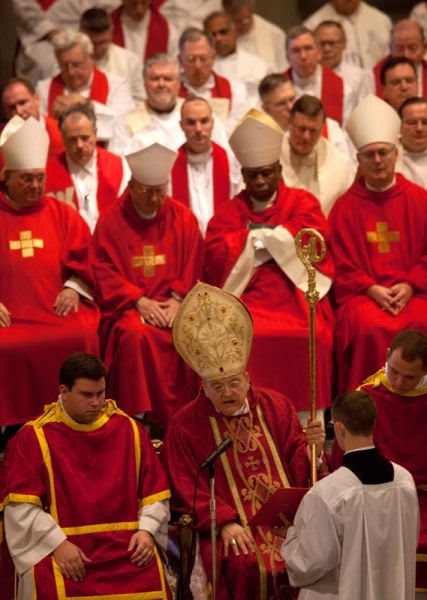
After the most recent Consistory, the newly-established Raymond Card. Burke’s celebrated a Mass of Thanksgiving at the North American College, a residence for American and Canadian seminarians studying in Rome. Coincidentally, the date of this Mass happened to fall on the feast of St. Cecilia. Here is the first part of the (lengthy but quite worthwhile) homily, which I found to be particularly moving for me in my vocation as a consecrated virgin.

There’s also a good article on Cardinal Burke’s Mass of Thanksgiving at the St. Louis Review, and you can read the full text of the homily in several places online, including here and here.

Comments in red and emphases in bold are mine.

***
Solemn Mass of Thanksgiving on the occasion of the Ordinary Public Consistory, November 20, 2010 - Memorial of Saint Cecilia, Virgin and Martyr
Praised be Jesus Christ, now and for ever. Amen.

Saint Cecilia whose memory we celebrate today was a wise virgin who carefully provided oil for her lamp, so that when her Lord came, He found her waiting and ready to meet Him with her lamp burning brightly. We know little about her life, but, from tradition, we know the essence of her heroic holiness. She was a young Roman maiden, who was raised in the Christian faith.

She, in fact, developed so strongly in her love of our Lord, through prayer and penance, that she resolved to offer her virginity to Our Lord as a perpetual gift, that is, to espouse our Lord alone as her Bridegroom for ever. Contrary to her resolve, her father insisted that she marry a certain pagan by the name of Valerian, but, on the day of her wedding, we are told that “amid the music and rejoicing of the guests, Cecilia sat apart, singing to God in her heart and praying for help in her predicament.”

One imagines that she was praying the words of the Psalms according to the ancient chant of the Church, which developed organically from the chant used in Jewish worship and continues today to be singularly suited to the raising of our minds and hearts to the Lord. (I think here Card. Burke might be referencing modern consecrated virgins’ vocation to recite the Liturgy of the Hours.)

The Lord heard her prayer, made even more pure and beautiful because it was offered to Him in sacred song. Through the help of an angel, her new husband was converted to the faith and received Baptism at the hands of the Bishop of Rome, Pope Urban. Having come to life in Christ through Baptism, Valerian fully respected Cecilia’s virginal consecration. With Saint Cecilia, he rapidly grew in pure and selfless love, and soon gave, with her, the supreme witness of total and faithful love of our Lord by accepting a cruel martyrdom for the faith.

In the life of Saint Cecilia, we see fulfilled, in a most striking manner, the promise of our Lord’s immeasurable and ceaseless love of all men, without exception, the divine love which we celebrate most fully and perfectly in this Eucharistic Sacrifice. Our Lord promises His holy people: “I will espouse you to me forever: I will espouse you in right and in justice, in love and in mercy; I will espouse you in fidelity, and you shall know the Lord.” (Hosea 2:19-20)

Our Lord called Saint Cecilia to espouse Him in love, to offer to Him her virginity, her whole being. Saint Cecilia responded with all her heart, placing her heart completely into the glorious pierced Heart of our Lord. In the Sacred Heart of Jesus, her love was purified and strengthened, so that the witness of her virginal love reached its fullness with the crown of martyrdom. The pure white of her love as a virgin found its consummation in the courageous scarlet of her love as a martyr for the faith.

The life and martyrdom of Saint Cecilia, in the few details which have come to us, like the life of every consecrated virgin, teaches each of us the reality of Christ’s love in our lives, a love which invites us to espouse Him, to be one in heart with Him in loving one another as He loves us, purely and selflessly.

Saint Cecilia, by her virginal consecration, teaches all of us the way in which Our Lord is calling us to give ourselves to Him and to His Mystical Body, the Church, and to all men, in love, whether we are called to lifelong, faithful and fruitful love in the married life, in the dedicated single life, in the consecrated life or in the priesthood. (As probably most of my regular readers know, Cardinal Burke was formerly the episcopal moderator for the United States Association of Consecrated Virgins when he was a bishop in the U.S.A. Although I respectfully disagree with some of his interpretations of canon 604, I’m very grateful for his efforts to foster a greater appreciation of the theological and ecclesiological value of consecrated virginity.)

On her feast day, we ask Saint Cecilia to pray for us, so that each of us will remain steadfast in responding to our vocation in life, so that we will never fail to provide oil for our lamps, so that, each and every day, Our Lord will find us waiting and ready to welcome Him, with our lamps burning brightly. We pray, through the intercession of Saint Cecilia, that Our Lord will find us always ready to give our hearts completely to Him.

Providentially, our celebration of the memory of Saint Cecilia coincides with the day on which we offer to our Lord the Holy Mass in thanksgiving for the Ordinary Public Consistory, held on this past Saturday, during which our Holy Father Pope Benedict XVI created new Cardinals to assist him in his shepherd’s care of the universal Church. The distinctive vesture of the Cardinal, the scarlet biretta and cassock, uncover the meaning of the position to which he is elevated.

The purity and selflessness of the Cardinal’s love of the Church, to whom he, as a priest, is espoused in a way analogous to the consecrated virgin, must be further purified and strengthened, in order that, in the words of the Successor of Saint Peter at the imposition of the cardinalitial biretta, the Cardinal may show himself to be “intrepid, even to the shedding of his blood for the building up of the Christian faith, the peace and harmony of the People of God, and the freedom and the extension of the Holy Roman Church.”*

The Cardinal has a particular bond with the virgin martyrs. They are a sterling example to him of how he is to love Christ and the Church, while, at the same time, they intercede powerfully for him, so that he may be a sign to the faithful of our Lord’s ceaseless and immeasurable love, “to the end,” (John 13:1) to the very outpouring of His life for us, on Calvary, His Sacrifice made ever present for us in the Holy Eucharist.

* This is a quote from Pope Benedict XVI at this past Consistory