Showing posts with label vocation. Show all posts

Sunday, January 16, 2022

Some Basic Advice for Discerners


One of the most common questions I’m asked as a relatively seasoned consecrated virgin is whether I have any advice for women discerning this vocation. This is also one of the trickiest questions to answer, because in real life my answer would depend a lot on the individual woman I’m talking to. For instance, my advice to a college student would be very different than my advice for a forty-something professional woman, which would also be different than my advice to someone who had recently left a religious community, etc.

Still, there are some very basic ideas that I find apply almost across the board. Some of these may go with out saying…but just in case they are helpful, I’m going ahead and saying them anyway!

1. Make sure you’re clear on what this vocation is actually all about

 If you feel called to discern a vocation to consecrated virginity, an important first step is understanding the fundamental nature of this form of consecrated life. Specifically, you should be clear on the concept that consecrated virginity is a public form of consecrated life for chaste and never-married women, centered around the charism of a spousal relationship with Christ, and which is lived out under the authority of the diocesan bishop primarily within the context of the local diocesan Church. And, as a public form of consecrated life, consecrated virginity involves some baseline obligations of evangelical witness, formal liturgical prayer, and service of the Church.

This point might seem overly obvious to many readers. But I find that sometimes people still have an impression of consecrated virginity as sort of a generic catch-all category, in which the main defining feature is simply being “not religious life in community”!  More commonly, well-meaning people can tend to confuse consecrated virginity with other vocations that are neither vowed religious life in community nor normal human marriage.

So just to clarify: consecrated virginity is not a private vow. A private vow is a wholly personal response to a sense of God’s call without any exteriorly-imposed parameters. Consecrated virginity, on the other hand, despite its flexibility in admitting a wide variety of practical lived expressions, is still a public commitment to a way of life that is exteriorly defined, governed, and formally approved by the Church.

Consecrated virginity is also very different from a secular Third Order. Third Orders (and oblate and community associate programs, etc.) are, essentially, modes for laypeople to share in the spirituality of a religious Order. But consecrated virginity has its own spirituality and charism that is district from any of the Church’s many religious families, and consecrated virgins are not “laypeople” in the usual sense of the term.

Consecrated virginity is also not the same as the so-called “lay consecrated life” of the newer lay ecclesial movements, since—among other points of contrast—the Ordo virginum is an ancient vocation dating back to Apostolic times and doesn’t involve an association with any group (unless of course you want to call the local diocese a “group”). Similarly, secular institute members and Opus Dei numeraries are not “consecrated virgins” in the technical sense of belonging to the Ordo virginum.

And finally, consecrated virginity is really not “the single life,” since consecrated virgins make a life commitment that is, theologically, truly nuptial.

All of these non-consecrated virginity vocations are still good vocations! But if you’re discerning consecrated virginity, you should have a good understanding of what it is you are discerning.

2. Do your homework

Or in other words, read and familiarize yourself with the relevant Church documents on consecrated virginity. In my opinion, the most important one to read is the Rite of Consecration to a Life of Virginity itself. I would even recommend multiple readings of the Rite of Consecration, perhaps beginning with a more straightforward academic reading if the Rite, and then subsequently re-reading it in a slower, more contemplative and prayerful way. The Rite of Consecration sums up the core spirituality of a consecrated virgin, so your inner spiritual attraction (or lack thereof!) will be an important clue about whether or not you’re called to this life.

Following that, another important document to read is the 2008 Instruction on the Ordo virginum, Ecclesiae Sponsae Imago (ESI). With a title that translates literally as “the Image of the Church as Bride,” this Vatican document address questions related to the nature and purpose of consecrated virginity in greater depth. The official intended audience of ESI is actually bishops and the canon lawyers assisting them, so a lot of ESI is written in somewhat technical language. Nevertheless, it contains some beautiful and very accessible passages, especially paragraphs 1 – 40; and even the more “dry” parts of ESI still communicate significant details about what the Church expects from her consecrated virgins.

That past three Popes have all given addresses and homilies to the Ordo virginum specifically, which are each worth a read:

May Christ be your total and exclusive love – Pope St. John Paul II (1995)

“To the Order of Virgins: Personal journeys in holiness at service of all” – Pope Benedict XVI (2008)

“Be ‘women of mercy’” – Pope Francis (2020)

You might also consider reading some of the Church’s writings on consecrated life in general, such as St. John Paul II’s work Vita Consecrata.

In terms of more devotional reading, Christ in His Consecrated Virgins by Ludwig Munster was originally written for pre-Vatican II Benedictine nuns preparing to receive the consecration of virgins after their solemn religious profession, but it’s still relevant for today’s consecrated virgins “living in the world.” It’s currently out of print, but you can read the whole thing online here.

Finally, Fr. Thomas Dubay’s book “And You Are Christ’s…” is kind of the go-to English language classic for introducing the basic theology and spirituality behind a commitment to dedicated Christian virginity of any sort. (Although, as a more mature consecrated virgin, I don’t find it as personally helpful as I did when I was younger, but I would still heartily recommend it to anyone discerning this vocation.) A similar book is Virginity by Fr. Rainero Cantalamessa, which has been translated from the original Italian into multiple languages. 

3. Find a good spiritual director

Yes, I know it’s hard to find a good spiritual director, etc. etc.

But seriously, really try your best here. Spiritual direction is something any woman seriously discerning consecrated virginity needs to make a priority. You absolutely need a good spiritual direction to help you in your discernment of this vocation—and if consecrated virginity does wind up being your call, then you’ll need a spiritual director post-consecration to help you with all the on-going discernment that this life requires.

If you don’t have a spiritual director or are struggling to find one, a great first step is to ask God in prayer to send you one. It’s amazing how often God will answer prayers like this through surprise providential encounters.

On your part, the active legwork involved in finding a spiritual director doesn’t have to be too mysterious or complicated. If you already know a priest that you find to be holy and sensible (and for whatever it’s worth, St. Teresa of Avila thought it was more important that spiritual directors be “learned” than that they be particularly holy!), you can start by just asking him if he would be open to doing spiritual direction with you. Even if he can’t take this on, he might be able to refer you to someone else who can. If you don’t know any priests whom you would feel comfortable going to for direction, you can try just asking your parish priest or maybe your diocesan vocations office for a referral.

Incidentally, a spiritual director doesn’t have to be a priest—although in my own personal anecdotal experience, it seems that holy diocesan priests in general tend to be the best at intuitively “getting” the vocation of consecrated virginity. And I do think there is some real benefit in an aspiring consecrated virgin having a spiritual director who is also committed to a life of celibate chastity in some way. But there are good spiritual directors among non-ordained religious, men and women in other forms of consecrated life, and lay people.

4. Try to meet consecrated virgins

If you are discerning this vocation, it can be very helpful to meet actual consecrated virgins in real life. If you don’t have any already-consecrated virgins nearby—and even if you do—you might consider attending the U.S. Association of Consecrated Virgins’ annual discerners’ conference.

Additionally, if there is a consecration being celebrated close to you, see if you can attend. The vast majority of consecration ceremonies are open to the public. Not only will you be able to experience one of the most beautiful ceremonies of the Roman liturgy, but you may even have the chance to meet consecrated virgins or other discerners who are also in attendance.

One caveat, however: consecrated virgins are a very “individual” bunch. Or to put a spin on the old saying: if you’ve met one consecrated virgin…you’ve met one consecrated virgin! Consecrated virgins share important things in common, but our consecrated lives are lived out in a variety of concrete ways. If you don’t “click” with the first consecrated virgin you meet, or even the first several, this isn’t necessarily a sign that you’re not called to this life.

5. Work to resolve any “crisis” or on-going issues in your life

For example, if you have a serious physical or mental health problem, do whatever you can to speed your recovery, if possible. Or for more chronic conditions, do what you can to manage them to the point where they’re not radically impinging upon the rest of your life. If you are burdened by major debts, make a real effort to pay them down. If you have a family crisis that is demanding most of your time and attention, either wait until your family circumstances get to a more stable place or find some way where your degree of personal responsibility within the situation can be adjusted to a more manageable level.

Sometimes discerners have the impression that, because consecrated virginity doesn’t entail the same kind of hard restrictions that religious communities generally have for new members, it’s no problem to discern consecrated virginity when you have an uncontrolled chronic illness, are deeply in debt, or have overwhelming family obligations. And there is a kernel of truth to this—consecrated virgins can own property and control their own finances, so it’s entirely possible for a consecrated virgin to responsibly pay off a student loan or mortgage on a house; and this life allows for a decent amount of flexibility and freedom, so it is possible for one consecrated virgin to live at a more “gentle” pace than others, or for consecrated virgins to assist aging parents in various ways.

But with that being said, before you start discerning consecrated virginity in earnest, it’s important to have your life in serene, stable, and healthy place. (Or at least as serene and stable as you can reasonably get it. Obviously, none of us are perfect and nobody is going to have a completely stress-free life!)

This is for a few reasons. First, a basic principle of any type of Christian discernment is that it’s easiest to listen for God’s voice amidst calm and peace.

Following that, it’s crucial to have a real sense of freedom when you’re discerning this vocation. If you are discerning consecrated life in general, it might be tempting to see consecrated virginity as an easier or less demanding vocational option than religious life since, as noted above, strictly speaking an aspiring consecrated virgin doesn’t need to be completely debt-free or in perfect physical health to be accepted as a candidate. But if you’re discerning consecrated virginity with a thought of: “Well, at least this is an option for me…”, that’s not a good sign. In order to discern consecrated virginity fruitfully and appropriately, it must be approached as a “first choice” vocation.

Additionally, the very same things that could make joining a religious community difficult can also present special challenges for living out a fervent consecrated life as a member of the Ordo virginum. Despite the high levels of personal freedom inherent in this vocation, we consecrated virgins still have real obligations and commitments by virtue of our state in life. While there can be exceptions in exceptional cases, if you’re thinking of becoming a consecrated virgin, you need to be able to take on a commitment to regular liturgical and private prayer, as well being realistically capable of undertaking some kind of apostolate or service of the Church. If you don’t see yourself as being able to do this, then it’s most likely not the right time in your life to be discerning this call.

6. Cultivate a spirit of openness

Hopefully it goes without saying that consecrated virgins are called to be mature adult women who can take pro-active responsibility for their own lives, think critically about nuanced questions, and who can make sensible decisions with confidence. Yet at the same time, it’s good to remember that a consecrated virgin is also called to a spirit of docility and openness, in the sense of truly wanting to know God’s will and do it, even if God’s will is something surprising, unexpected, or something which goes against her personal preferences or is outside of her comfort zone.

This call to a spirit of openness applies doubly (if not triply, or four times as much) to women still just discerning this vocation. It’s important to be open to the idea that the Ordo virginum may be where God is calling you…but conversely, in your initial discernment it’s also important to be open to the idea that God just as well might not be calling you to consecrated virginity after all.

And if you and your bishop do discern that you’re called to consecrated virginity, then you’ll also need to have a spirit of openness towards formation. Even if you’ve been doing your best to “live the life of a consecrated virgin,” at the end of the day you really can’t life the live of a consecrated virgin fully unless and until you actually are consecrated. Knowing your need for formation is a strong sign of a genuine vocation, whereas feeling convinced you have it all completely figured out is a red flag in my mind.

And don’t forget, even after consecration on-going formation is a life-long project! The consecrated virgins in my own life whom I most respect and admire also happen to be the ones most interested in continuing to study and delve deeper into the Church’s teachings on what it means to be a consecrated bride of Christ.

7. Pray, pray, pray…and then pray some more

Praying to know God’s will for your life is such standard advice I almost forgot to list it here! But it’s standard advice for a reason. You can’t learn to listen for God’s voice if you don’t have a real listening relationship with Him, which is what prayer essentially is. And since the heart of a consecrated virgin’s vocation is a spousal relationship with Christ, the “relational” aspect of prayer is absolutely essential. You can’t have a relationship with a theory or idea, but only with a person, and a vibrant prayer life is the only way to establish this kind of person-to-person relationship with Christ.

Beyond this, I think it would be helpful for a discerner to try adopting some of the specific elements of the prayer life of a consecrated virgin, especially daily Mass whenever possible, dedicated time for silent prayer, and the Liturgy of the Hours.

But once again, keep in mind that at the end of the day, you can only truly have “the prayer life of a consecrated virgin” once you are a consecrated virgin. Actually being consecrated really does entail a significant shift in your interior spiritual life. And also, if this is your call, ideally you should have years to ease yourself into the amount of daily prayer time expected of a consecrated virgin. So, be sure to set realistic goals for your prayer life as a discerner and don’t let yourself get discouraged if it seems like a lot at first. Just take the first step.

Monday, May 25, 2020

Letter to a Newly Consecrated Virgin

Dear sister in Christ,

Maybe we know each other in real life, or maybe we’ve only “met” over the internet, or maybe you’ve just stumbled upon this blog. We may have corresponded over many years, or we may have just exchanged one or two emails, or perhaps you don’t know me at all. Whatever the case may be, if you are a newly-consecrated virgin, I first of all send my warm and heartfelt congratulations. I hope your consecrated life brings you many years of joy and happiness, crowned with an eternal reward!

I know it’s usually presumptuous to offer unasked-for advice, but I remember when I was in your shoes—that is, newly consecrated and happy about it, but still trying to “find my feet” in a new vocation—and I think it would have helped me to have had some more honest insights about the lived reality of life as a consecrated virgin. My own thoughts at this point may or may not resonate with you, but after living more than a decade of consecrated life myself, hopefully I’ll still have something helpful to share.

And so here are some of the things I wish an “older sister” would have said to me all those years ago:

1. This is just the beginning of a new life.

Your consecration may have in some ways felt like a culmination, or like a conclusion of some sort, but it wasn’t; it was only the very beginning of a new life. This might be a bit more readily obvious to those of us who were consecrated in our twenties or thirties (though even for us younger ones, there still might have been a sense of “finally, I’m done discerning my vocation!”). But I think this is true for newly-consecrated virgins of all ages.

Consecrated virginity is unique among forms of consecrated life in that presumes that we have already been living an exceptionally chaste life for a number of years. Or really, it presumes that our entire lives have been virtuous in this way. Yet our consecration isn’t meant as a reward-like recognition or acknowledgment of this. Rather, as the Rite of Consecration tells us, it’s a call to continue living this life of virtue “with a new grace and [consecrated] to God by a new title.” In our consecration, the natural virtue of chastity, which even the classical pagans valued, takes on a new supernatural dimension as an eschatological sign of Christ’s love for the Church. And in addition to the universal call to holiness we received at baptism, in our consecration we are embracing a new, special, and privileged call to be a bride of Christ in a radical and more literal way.

Of course your consecration day itself will always be important in your memory. But I think you’ll find that if you live your vocation well, over the years the emotional and spiritual weight of the day will start to feel very secondary to the many years of fidelity you will have offered the Lord. In fact, I think there may be even greater joy in perseverance. Each passing year of your consecrated life becomes a self-gift you offer to your divine Spouse, a gift which is just as precious as that first self-offering you made on your consecration day.

2. Your life is different now.

Even if prior to consecration you were sincerely striving to “live the life of a consecrated virgin,” and even if your exterior life looks the same, the fact of the matter is that your life is different now. And so are you!

This isn’t talked about as much as it probably should be, and my impression is that many newly-consecrated virgins often feel a bit unsettled post-consecration without really knowing why. But I think this is due to the “growing pains” involve in adjusting to a new identity. It takes time to adjust to a new identity, but I believe that in most cases this struggle is normal and healthy. I actually think I would be more worried about a new consecrated virgin who didn’t struggle at all with this, because it would make me wonder if she was fully processing what had happened to her spiritually or if she was fully grasping the weight of what she had committed to.

On an interior level, among other things, you may find yourself being drawn to a greater spirit of simplicity or evangelical poverty—that is, a more profound detachment from worldly things. This is really a great grace!

Don’t resist this grace, even if it might conflict with your idea of what life as a consecrated virgin is supposed to be like. Maybe let go of some ideas, such as the thought that you’ll be something like “a normal woman living in the world like anybody else.”  Naturally, you probably will blend in a little better than a nun or fully habited Sister would, and the hope is that people will see you as approachable. But the consecration will make you different from laywomen, as well making you a bit weird from a worldly perspective. But let your “weirdness” unfold naturally according to the inspirations and providential circumstances the Lord sends you, so that this weirdness can serve His purposes.

There will also be some practical adjustments involved in assuming your new vocation, which may seem subtle from an outside point of view, but which will still require some careful discernment on your part. You are a public representative of the Church now, and we can rightly say you are now an icon of the Church, or an “image of the Church as Bride” (i.e., an “Ecclesiae Sponsae Imago”). To a significant extent, everything you now do should be an expression of what the Church would do. E.g., when you are kind and fair, even in the small interactions of daily life, this is a reflection of the Church as loving and just. Our sins are of course our own and nobody else’s, but the other side of this coin is that our lack of kindness, patience, courage, or any other virtue has the potential to reflect badly on the Church in the eyes of others. And in general, when you have entered a public state of consecrated life, the faithful will expect more of you…as they are indeed fully entitled to do.

Because of this, it may be necessary to re-evaluate certain aspects of your life. For example, you may find you need to be more reserved in some ways, or more selective about whom you let into your circle of close personal friends. There might be some social invitations that, while not sinful, you will need to gracefully turn down. Or on the other hand, you might also find you need to be more friendly or even “pastoral” to people you otherwise wouldn’t have talked to! You may even discern it’s necessary to start dressing or introducing yourself differently.

It can be a bit daunting at first, but be patient with yourself as you do this hard work of discernment. (And obviously keep in conversation with your bishop, spiritual director, and trusted mentors as you do this!)

3. Know that you’re still being formed.

At this point in history, it can more or less be taken for granted that a newly-consecrated virgin today (at least in the United States) will not have had a perfect formation experience. This makes sense when you consider how relatively recently the Ordo virginum was revived as its own distinct state in life.  Even in a best-case scenario, with an attentive bishop motivated to provide a decent structured formation program, as a contemporary Church we simply don’t have enough collective lived experience to provide formation that is perfectly comprehensive for all aspiring consecrated virgins everywhere. That is, it’s likely going to take us a while longer to figure out exactly what the specific formation needs of consecrated virgins are, along with the best practical ways to address these needs. (Though as a point of reference, consider that it wasn’t until the Council of Trent in the sixteenth century that the Church adopted the first versions of our modern seminary system for the formation of priests!)

Although this does put us at an obvious disadvantage, I think much of the disadvantage of having had a less-than-perfect formation experience can be mitigated by simply being aware of and accepting the reality of the situation. Being aware of our areas for potential or needed growth can help us take care to make up for what is lacking, and “knowing what you don’t know” is crucial for avoiding mistakes that our possible blind spots may cause.

Also keep in mind that the Holy Spirit is the best of all formators, and He will help us in the ways we need, but only if we are truly docile and open to Him.

And alluding to my earlier point, receiving the concretion itself is a highly formative event. No amount of prior study can compare to the experience of actually being consecrated. So even if you were blessed enough to have had an excellent formation program, know that post-consecration you are still being formed by both your lived experience of consecrated life and by the graces you received in your consecration. God willing, each passing year as a consecrated virgin will make you an ever more fitting spouse of Christ.

4. You’ll have share in the cross in a new way.

The Church describes even natural human marriage as “a partnership of the whole of life.” (CIC canon 1055 §1) Spouses are called to share everything, including all their joys and sorrows. This is true also for those of us who have Christ as our spouse. In a mysterious way that words can’t quite describe, your consecration will give you a new and more intimate window into Christ’s suffering and passion.

This is not just pious sentiment. In my own experience and having talked with numerous consecrated virgins over the years, it seems to be quite common that new consecrated virgins will encounter some sort of new and extraordinary—and at times even uncanny—suffering shortly following their consecration. This might be the result of exterior life circumstances, a purely interior spiritual trial, or some combination of these.

Of course, suffering by definition is never pleasant, and I certainly wouldn’t wish it on anyone, much less my sisters in the Ordo virginum. But if there is a consolation in this, to me when a newly consecrated virgin does encounter some sort of unexpected trial, paradoxically I’m inclined to see this as a positive sign in her vocation. That is, it can be a sign that her consecration really “worked,” and that Jesus took her at her word when she said “yes” to His call to a life of greater union with Him.

The old saying that God can never be outdone in generosity is certainly true. And for the sake of a healthy spirituality in consecrated life it’s important to remember that while God at times permits suffering for a greater good, He does not actively desire us to be in pain—and in fact, it’s God’s will to bring us to a place where “He will wipe every tear from [our] eyes, and there shall be no more death or mourning, wailing or pain.” (Revelation 21:4)

But for those of us who have committed to remaining with Jesus “wherever He goes,” (cf. Revelation 14:4) we can look on it as a privilege when He invites us to remain with Him so personally in His darkest but most triumphant hour.

5. Your happiness, even in this life, will depend on your generosity.

Finally, perhaps the most important thing to understand about living out a vocation to consecrated virginity is that there really are no half-measures. A consecrated virgin either gives the Lord absolutely everything, thereby receiving everything (and more!) from Him in return; or else her life becomes empty, silly, and fruitless.

I think this point is worth spelling out, because a common misconception among women first discerning this vocation is that consecrated virginity is sort of a way to have one’s cake and eat it, too—as in, a way to nominally “give everything to God” while still maintaining all of one’s worldly interests and activities as usual, or as a way to receive the graces and honors of consecrated life in the Church without having to make the often painful sacrifices inherent in joining a religious community.

This fundamental misunderstanding of our vocation is insidious because it contains a small grain of truth. For example, consecrated virgins generally don’t have a moment equivalent to crossing the threshold of an enclosure like a postulant in a cloistered monastery does, nor do consecrated virgins typically make a point to limit contact with family and friends or restrict their communication with “the world.”

Yet readily apparent or not, consecrated virginity still demands a radical shift in perspective and attitude from “worldly” orientation to one deeply informed by the Evangelical counsels. This is not just something the Church specifically asks of us—although she does (see ESI 27)—but it’s something built into the very nature of our commitment.

Marriage natural parenthood are so deeply inscribed in the human heart that the act of altogether renouncing these things leaves a void. The idea in consecrated virginity, or even consecrated celibacy in general, is that we allow Christ to superabundantly fill this void. But the catch is that He can only do this is He is the only one we allow to fulfill us in this way.

If we try to fill the void with other human things, even other intrinsically good human things, inevitably such things will come to be seen and understood as trivial in the at least the big picture. Devoting ourselves to things other than Jesus Christ and His body, the Church is what will leave us a the sad and gloomy old maids that Pope Francis warns against (cf. his May 8, 2013 address to Superiors General) instead of the radiant brides of Christ and spiritual mothers that we are called to be.

Obviously, as a newly-consecrated virgin you are far past the question of discerning your state in life, and thus beyond the concerns and misperceptions of those who are first inquiring. But sometimes, in the midst of the fatigue that can come about in the day-to-day life of a consecrated person, it can be easy to forget about the joy of a total self-gift. When God seems silent or the Church seems unsupportive, it can be tempting to grasp at consolation wherever we can find it, even in the passing things of this world. But we need to remember, as the Prophet Isaiah wrote: “Why spend your money for what is not bread; your wages for what does not satisfy?” (Isaiah 55:2)

In all circumstances of life, including the challenging ones, the surest way to happiness is to turn your heart ever more intently towards your Divine Spouse.

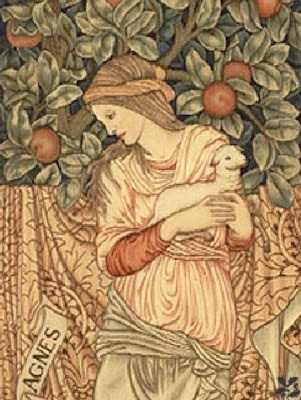
Our holy sister St. Agnes was said to have gone to her martyrdom more joyfully than most people go to their weddings. If we imitate the single-hearted intensity with which St. Agnes gave herself to the Lord, I am certain that we will also share in her deep and astonishing joy.

With love, in Christ,
Jenna

Saturday, June 8, 2019

Tenth Anniversary Reflection


Better late than never!

This past January, I celebrated my tenth (!!!) anniversary of consecrated life. It has been an interesting ten years—since my consecration day, I have spent three years living in Rome, finished two graduate degrees, written a book and several popular articles, served as a parish director of religious education and as an ecclesiastical tribunal Judge, made numerous wonderful friends, and have grown in many other ways personally and spiritually. Over all, I am grateful to God for the gift of perseverance!

Here is the anniversary reflection I wrote for the February 2019 issue of the U.S. Association of Consecrated Virgins' newsletter, “The Lamp”:

***

After a life-long friendship with God, I first felt called to be a bride of Christ when I was twelve years old. I just fell completely in love, once and for all. At eighteen I began visiting religious communities, and while I met a number of admirable nuns and religious Sisters, none of the communities I visited completely resonated with the specific way I felt called in my heart. When I was nineteen, a local priest gave me a copy of the Rite of Consecration to a Life of Virginity, and upon reading it I knew instantly that this was my vocation. In particular, I was drawn to the central charism of a spousal relationship with Christ; to the spirituality of evangelical virginity; to this vocation’s special bond with the local diocesan Church; toward the Rite’s emphasis on praying the Liturgy of the Hours; and especially to the fact that this vocation was a call to follow in the footsteps of the Church’s early virgin-martyr saints, like St. Agnes and the other women mentioned in the Roman Canon at Mass.
           
Initially I was turned away from the consecration of virgins for being too young, but after two more years of visiting religious communities, I tried approaching my home Archdiocese of New York again, and at that point I was accepted as a candidate for consecration. I was solemnly consecrated to a life of virginity at Sacred Heart Church in Newburgh, NY on January 3, 2009, when I was twenty-three years old and a recent college graduate.
           
I can honestly say that I am even happier to be a bride of Christ now than I was on the day of my consecration. Although there have been many challenges over the past ten years, they have only made my vocation more precious to me. As I’ve grown older, I’ve found I have a new sense of glad astonishment that God would be so gracious as to call me to this kind of relationship with Himself.
           
As I reflect on my tenth anniversary of consecrated life, one image that has been frequently coming to mind is the Lamb of God. Most obviously, consecrated virgins are called to be “the Image of the Church as Bride”; that is, the “Bride of the Lamb” mentioned in Revelation 21:9.

But more personally, the Gospel for the actual day of my tenth anniversary was John 1:29-34, where John the Baptist points to Jesus and declares: “Behold the Lamb of God.” I was reminded by the priest celebrating a Mass of Thanksgiving that day that this is my mission, too—to be a witness pointing others towards Jesus, who is the Lamb.

I was reminded as well that as lambs were used for sacrificial worship in Old Testament, Jesus is the Lamb of God because he offered Himself as a sacrifice.  On the day of my consecration it was very much my hope and intention to offer myself as a living sacrifice to the Lord in the same spirit that saints like Agnes offered their lives. It can be easy to forget the joy that comes with a spirit of radical self-offering, but ten years after my consecration I’ve realized how important it is to continually renew this resolve in my heart.

Finally, my consecrated life has brought me to places I never would have guessed, including three years living in Rome as a canon law student; and then later, an unexpected but clearly providential call to serve the Church in the Diocese of Winona-Rochester in Minnesota as a staff canonist and coordinator of the marriage tribunal. Even amidst the difficulties of leaving home and family for a new and unfamiliar place, there’s a greater peace in recalling that virgins are the ones who “follow the Lamb wherever He goes.” (Revelation 14:4) My prayer after ten years is that I will always be given the grace to follow the Lamb wherever He leads me.

January 3, 2009

January 3, 2019 - after a Mass of Thanksgiving, in the very same Church!


On the feast of St. Agnes, a second Mass of Thanksgiving in Minnesota,
in our Diocesan Office chapel with local diocesan priests.

Friday, January 3, 2014

Anniversary Reflection

“IHS” is a traditional symbol for the Holy Name of Jesus
January 3, 2014 is the fifth anniversary of my solemn consecration to a life of virginity. Even after five years it’s still hard for me to find the words to write a reflection on the day. So instead, I’ll just share one small memory:

I originally chose January 3 as my consecration day, because I knew I wanted to be consecrated during the Christmas season, and that year January 3 happened to be the eve of the Epiphany. And January 3 is also my onomastico—that is, the feast of my patroness St. Genevieve, who herself was a consecrated virgin.

What I was not totally aware of at the time was that January 3 is also the feast of the Holy Name of Jesus. But what might have been simply a liturgical happy accident instead led me, providentially, to see a new shade of meaning within my vocation.

The night before my consecration, a local Poor Clare monastery let me spend the night in their guestroom, so that I could spend that last night under the same roof as Jesus in the Blessed Sacrament, so as to then be more recollected for my consecration day. In the morning, I joined the nuns in their chapel for their early prayers.

Since, as I then found out, the Holy Name of Jesus is an important feast for Franciscans, the nuns had a special commemoration of the day in their celebration of the Liturgy of the Hours. Their Franciscan Office books had all the beautiful proper prayers, readings, and antiphons which I didn’t have in my own “standard-issue” Roman breviary. So although I had not planned it this way, I found myself meditating specifically on the significance of the Most Holy Name in the final hours leading up to my consecration.

As I sat in the chapel, singing the Office along with the nuns, it came to my mind that if I were marrying a mortal spouse that day, I would be changing my last name to my new husband’s—and therefore “losing” my own name in a certain sense. It reminded me of how, when I was a very young, it used to strike me as a bit unfair that women generally took their husbands’ surnames, and were sometimes even addressed by their husbands’ name alone (as in: “Mrs. John Smith”).  To be very honest, when I was a little girl I used to marvel at how much you would have to love somebody to allow your own name to be basically taken over by his!

But that bright winter morning, I suddenly thought: how happy I would be if my name could be hidden under Jesus’ in the same way that a wife’s is hidden under her husband’s! In Jesus, I had truly found the one whom I loved enough so as to be willing to lose my own name.

Of course,  it should go without saying that God, who deliberately created us as unique individuals, doesn’t will that we should give up our own personalities when He calls us to consecrated life. And naturally it would sound a bit silly if I took to calling myself something like “Mrs. Jesus.” Still, at that moment, I couldn’t think of a greater joy or privilege than to be known simply as Jesus’ spouse.

Sacred Scripture and the Church’s teachings paint us a stunning picture of the power and majesty of the Holy Name of Jesus: 
…God greatly exalted him and bestowed on him the name that is above every name, that at the name of Jesus every knee should bend, of those in heaven and on earth and under the earth, and every tongue confess that Jesus Christ is Lord, to the glory of God the Father. (Philippians 2:9-11)

But I am also grateful that every year this feast also gives me a chance to savor this mystery in a personal and more intimate way, as I remember my consecration day and how I felt that joyful longing to give myself over entirely to the one who bears the Most Holy Name.

Saturday, May 1, 2010

In Memoriam

Last week, the father of Fr. Luke Sweeney—Vocations Director in the Archdiocese of New York and creator of “NYPriest.com”—entered into eternal life. As I was blessed to have known Mr. Sweeney personally (and in honor of this feast of St. Joseph the Worker, foster father of Jesus), I thought I would re-print this article as a tribute. It was written by Fr. Luke about a year ago for “Fathers for Good,” an initiative of the Knights of Columbus.

***
“Father of the Father”

My dad loves to recall a defining moment of his becoming a father late in life, at age fifty. His habit was to come home and read the newspaper, but when I was a toddler, I must have come over and swiped the paper out of his hands. The light went on in his mind and he realized that in my childlike way I was asking my dad to play with me. He took the hint and threw his heart into doing things with me then and throughout the years.

The presence of a father is invaluable in a boy’s life. As a vocation director I witness the wounds left when fathers are physically or emotionally distant from a young man. There can be anger that builds up, problems of relating in an appropriate masculine way and difficulties in school.

I have been blessed with my dad’s continued active presence in my life.

While my mother was more vocally and explicitly Catholic, praying with me at bedtime and listening to Christian radio, my dad’s presence was always quiet, but clearly there. At different times he offered words of wisdom. He taught me how to golf, threw the football with me, and even once dug up grass from the backyard for a history project.

A short while ago I asked my dad if he had ever stopped going to church over the years. He said never. What a wonderful job his family and the priests and religious sisters did for him when he was young! They set him on a good path and he never strayed.

My father has recalled for our family on numerous occasions his days in the U.S. Navy during World War II, and how incredibly quiet and focused the crew was before a battle. Most were deep in prayer, begging for grace and preparing for death. Perhaps his trust and reliance on God during those years deepened his commitment.

My dad’s presence and practice in the faith was never lacking. I always felt encouraged to get involved with the Church through his example. He was involved as an usher, volunteer for the Cardinal’s Annual Appeal, and as a parish trustee. He went to Mass, stayed afterward for the rosary each week and would go to Stations of the Cross during Lent. We also did these things as a family.

I began talking about the possibility of a priestly vocation in the sixth grade, and my dad took me to the seminary to meet the rector when I was a senior in high school. His words of wisdom were, “No matter what you decide to do in life, your mom and I will love you and support you!” What a sense of freedom to follow God’s will and not be forced to live out a parent’s preconceived plan for my life.

My mom died of a brain tumor right after I was ordained a deacon. My dad and I were present at her passing. Now that I am a priest, my dad has become a person that I talk to about how things are going (he constantly tells me to pace myself), but also someone I now pray with. We pray the rosary when driving together in the car, and sometimes I have the privilege of offering Mass in a hotel room when we travel together. Whatever the occasion, my dad is prouder than anything to be the “Father of the Father.”

Recently, we both went to confession while on vacation. Without missing a beat, he took from his bag a little old military prayer book from the 1940’s which he had used all these years to prepare himself for the sacrament. His strong and basic faith had seen him through battles, and it continues to guide, renew and nourish him daily. His love and devotion to Jesus and the Blessed Mother have had a great effect on my life, and there is little mystery that I was able to hear God’s call.

(photo: Fr. Luke Sweeney, his father Mr. Luke Sweeney, and Archbishop Dolan)

Saturday, January 19, 2008

Some Thoughts on the Question "Why This?"

Oddly enough, I find it much more difficult to explain why I am becoming a consecrated virgin specifically than I do trying to explain why I wish to embrace the consecrated life in general.

In many ways it would seem to make much more sense for me to join a religious order. Many, if not most, religious orders need more young women to join if their community is to continue its service to the Church. In all likelihood, if I entered the convent I would be helping to fulfill an established need. Further, if I became a religious I would undoubtedly find much more support and guidance as I strive to live as a spouse of Christ. So on the surface at least, opting for membership in a religious institute would seem to be a more prudent decision.

The only real response I have to these valid concerns is that I am trying to do what I sincerely think God wants me to do. At the end of the day, I'm of the opinion that the "why" of a person's vocation is something only God understands. However, there are some aspects of consecrated virginity in the world which particularly resonated with my sense of a call.

One of the qualities of this vocation which I found most attractive was its universality. One difficulty I encountered in discerning religious life was my disinclination to adopt any particular spirituality or mode of prayer.

While I wholeheartedly agree that the spiritualities of the various religious families are a great gift to the Church, I never really felt that I was meant to be a Benedictine, a Franciscan, an Augustinian, a Dominican, or a sister of anything else. I wanted to be consecrated, but just as a Catholic! As I see it, the spiritual heritage of a consecrated virgin is the spiritual heritage of the universal Church.

Similarly, in my own personal situation I felt that my identity as a consecrated woman should be based essentially on my spousal relationship with Christ, independent of any sort of specific work or apostolate. Religious institutes by their very nature reflect a particular mission; that is, they arise in order to fulfill a certain need. Yet I felt that my "mission" was simply to participate in the general mission of the Catholic Church.

Thursday, January 17, 2008

Feast of St. Anthony

Today is the feast of the "original" St. Anthony. Born in Egypt around the year 250 A.D., he is called "the father of monks" because he was one of the earliest hermits in the Christian tradition.

Most of what we know about St. Anthony is from a biography written by St. Athanasius. According to St. Athanasius, when St. Anthony was about twenty he walked into church and heard the Gospel parable of the rich man who was told by Christ: If you want to be perfect, go and sell all you have and give the money to the poor....Then, come follow me.

In order to devote his entire life to Christ, St. Anthony went out to desert with the intention of spending the rest of his life in solitude and prayer. His reputation for holiness soon attracted followers (so he didn't exactly live in complete solitude). This was the beginning of monasticism, and thus it was also the primitive foundation of religious life as we know it today.

It is still possible to be a hermit this day and age. There are contemplative religious orders (such as the Carmelites) who have an eremitic spirituality, and other orders (like the Carthusians) whose members actually spend the majority of their waking hours alone with God. The 1983 Code of Canon Law, in addition to restoring the ancient order of virgins, also makes provisions for non-religious hermit in can. 603.

In other words, if you felt called to be a hermit like St. Anthony, you could figure out where and how you would live this life, and then ask for your local bishop's permission and blessing. If the bishop supported you in this endeavor, you would be and "official" hermit in the eyes of the Church. Not many people chose this path, for practical reasons as much as spiritual ones, but it does remain an option!

While I personally have never felt called to be a hermit (although for some reason a couple of priests have suggested that I seriously consider it), I do appreciate the eremitic vocation. I find the concept of constant prayer and total dedication to God very attractive from my own subjective point of view. And objectively, I think it is important that we have people like this in our world today.

I think the charism of St. Anthony's life is very well encapsulated in his prayer from the Breviary:

Father, you called Saint Anthony to renounce the world and serve you in the solitude of the desert. By his prayers and example, may we learn to deny ourselves and to love you above all things. We ask this through our lord Jesus Christ, your Son, who lives and reigns with you and the Holy Spirit, one God, for ever and ever.

Wednesday, January 16, 2008

My vocation story, part III

Shortly after I began having unsettling thoughts about my potential lack of a vocation, by sheer providence I happened to meet a young priest from a neighboring parish. He took it upon himself to offer me some guidance, and he was willing to go out of his way to help me.

Besides talking with me about vocation (and listening to what I had to say!), this priest also gave me some really helpful reading material. Among other things, he also xeroxed for me the entire section of the 1983 Code of Canon Law which pertains to the consecrated life. In reading this I came across can. 604, which was when I realized that consecrated virginity in the world was still a form of consecrated life recognized by the Church. (I wonder at times if I am the first woman in Church history who found her vocation by reading Canon Law!)

Something about this grabbed my attention, so the same priest later gave me a copy of the Rite of Consecration to a life of virginity. (You can read it here.) Upon reading the rite, I felt as though I had found what it was that God wanted me to do with my life. I wish I could explain this in more detail--and I can identify reasons for my attraction to consecrated virginity, but it would take another post to try to discuss them--but I suppose I really can't. I think that being "called" is ultimately a mysterious thing.

A few months later, the priest called the appropriate people in our archdiocese on my behalf. He was told that I was too young to be considered for the Rite of Consecration. I was nineteen years old at the time.

In addition to this another priest, the one who was hearing my confessions at the time, thought my discerning any vocation was a bad idea in general (he wanted me to wait until I finished college), and that my discerning consecrated virginity in the world was particularly unwise.

So, I decided that I must not have been discerning properly after all. I spent about two more years visiting different religious orders in the hope that I would find where God wanted me. I encountered some very excellent communities and met many admirable religious during this time, but I could never completely forget the idea of consecrated virginity in the world.

When I was twenty-one I transferred to my present university, and met a handful of priests who were supportive of my interest in consecrated virginity. I think this made all the difference, because I somehow found the nerve to be honest with myself about what it was to which I was actually being called.

I had kept in touch with the young priest who had first encouraged me, so I mentioned to him that I was still serious about becoming a consecrated virgin. I asked him to do what he could to help me in this--and he did. He arranged for me to speak with the priest in charge of the consecrated virgins in our archdiocese, and the three of us met shortly after my twenty-second birthday. After meeting me, the priest in charge told me he would be willing to consider me as a candidate for consecrated virginity, despite the fact that I was extraordinarily young. Deo gratias!

So this is where I am now. I am still at the point where I could be told tomorrow that I don't have a vocation or that I'm too young (though I'm not anticipating this). And as a hopeful aspiring theologian I still have a lot to do academically to get my future in order. I'm happy and excited about my life, and I trust God. But I still feel that I need all the prayers I can get!

Tuesday, January 15, 2008

My vocation story, part II

Deciding to give myself completely to God at the age of twelve presented some unique challenges--not the least of which was simply growing up!

I assumed that my "call" to a life of virginity meant that I would become a nun or a religious sister. But as this was the late 1990's, I really didn't know any religious very well, so there was no one to whom I could bring my questions. My parents, who were and are devout Catholics, did not want me so much as to think about religious life until I was in college. And even so, they made it clear that I was to earn at least a bachelor's degree before I entered the convent.

When I was fourteen I started ninth grade at our local public high school. I found this environment difficult, as my religious devotion stuck most of my teachers and classmates as odd (or even crazy!). I was never the least bit tempted to ignore my faith, although I did occasionally question my vocation to consecrated life. Still, my sense of being called was so strong that I chose not to date or have any romantic relationships while I was a teenager.

I went away to college when I was eighteen, and within two weeks of being there I called the local diocesan vocation office. Diocesan vocation offices really exist to help potential diocesan priests, but the vocation director was still able to put me in touch with some local women's religious communities.

This is when I first began to visit convents. At first, I felt as though a huge burden had been lifted off my shoulders; it seemed to me that I had kept my vocation bottled up inside of me for so long, and it was such a relief to be talking about it finally.

However, it was not very long before I started to have this vague sense that God did not want me to enter a religious community. I found this quite upsetting, because I still felt very strongly called to a spousal relationship with Christ.

Wednesday, January 9, 2008

Just in Time for National Vocation Awareness Week: My vocation story

My intention in writing this blog is really to share my thoughts on "objective" and exterior issues related to consecrated virginity in the world, in the hope that my reflections may be helpful to some people. Generally, I find it immodest to speak about my personal spiritual experiences in public.

Vocation stories are sort of borderline in this regard. On the one hand, the sense of being called by God is always immensely personal. But on the other hand, this interior event by its very nature has some wide-reaching consequences for other people. And I think it is necessary to be prepares to explain (at least somewhat) why it was that you choose a particular state in life.

Also, I think my thoughts would probably make a lot more sense if they were given some context. So, this is the first part of my story:

I was always fairly pious as a young child--I have memories of reading the Bible on my own when I was about eight, and I used to tell my grade school classmates that I considered Jesus to be my best friend. But I never considered any form of consecrated life because I wanted to be married and have children. I even used to make a point to take extra good care of my dolls, because I anticipated passing them down to my own little girl one day!

This changed in the middle of the sixth grade, when I was twelve. At this time, I started to sense very strongly in my prayer that God wanted me to give myself entirely to Him by means of my living a life of virginity. Even at this young age, I was blessed with an understanding--albeit not a very developed one--of the beauty of consecrated celibacy.